
The TCPP03-M20 is ST’s first USB-C port safety machine for twin position energy (DRP) purposes, that means that it’s going to serve programs designed as a supply (charger) or a sink (charging). In probably the most simplistic phrases, the element brings collectively the TCPP01-M12 (sink) and the TCPP02-M18 (supply) featured on the ST Weblog. As an illustration, it contains their gate drivers to guard in opposition to over-voltage and over-current on the VBUS. Equally, the TCPP03-M20 embeds the identical present sensing aspect because the TCPP02-M18 and an equivalent discharge path on the VBUS and VCONN. Nonetheless, it additionally contains energy consumption states to assist engineers optimize the purposes which might be clamoring for dual-role energy safety.
The Rise of Hybrid Functions
Why Twin-Function Ports Are a Flagship Characteristic?
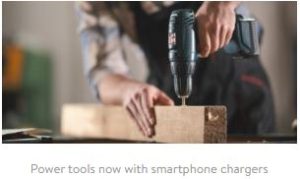
Hybrid purposes, which combine charging an inner battery after which utilizing that battery to cost a cellular product like a smartphone, have gotten flagship options. As an illustration, exterior batteries are getting smaller. Beforehand, makers would dedicate one port to cost the interior battery and one other to cost exterior merchandise. To save lots of house and enhance the consumer’s expertise, engineers now use a single dual-role port for each roles. Equally, producers are including USB-C ports to merchandise that beforehand did not have any. As an illustration, batteries for energy instruments use dual-role energy ports to extend their attraction. Customers can use the port to cost the interior battery and cost smartphones or tablets when within the subject.
The place Did the Development Originate?
The brand new market developments appear to reply to shopper calls for somewhat than laws. Certainly, the TCPP01-M12 and TCPP02-M18 provide options to the distinctive challenges introduced by the European Union’s selections to harmonize charging ports. As merchandise all use USB-C, it’s important to guard in opposition to edge circumstances and poorly designed programs. But, the rise of dual-role energy purposes would not come from European rules. As a substitute, producers are lastly implementing a long-standing promise of the USB-IF. Certainly, the Discussion board first launched the DRP as early as 2016 throughout a developer’s convention. Since then, the press has been selling this function. Producers are actually in a position to ship it to customers.
TCPP03-M20 and the Challenges of Twin-Function Energy Ports
Why Does Twin-Function Port Safety Want Extra Energy?
Releasing hybrid purposes took time partly as a result of designing a system supporting sink and supply is difficult. In essence, a USB-C port in a sink mode will use a pull-down resistor whereas a supply element will depend on a pull-up resistor, and a twin position connector will change between the 2. Nonetheless, whereas the basics are easy, engineers face optimization challenges to create environment friendly programs. As an illustration, designing a PCB with a big exterior USB-PD controller supporting DRP typically signifies that the safety machine will typically draw greater than 15 A when there is no cable hooked up. Certainly, the safety machine have to be prepared for each a supply and a sink utility till it may well make a dedication.
How Does a Companion Chip Assist Enhance Effectivity?
The TCPP03-M20 gives new options to the facility consumption challenges as a result of it really works as a companion machine with the USB PD controller discovered inside STM32 microcontrollers. The embedded nature of the answer means fewer exterior elements and better coordination with the processor. As an illustration, the safety machine can use a hibernate mode by default when no cable is hooked up. The I2C interface is energetic, permitting the microcontroller to ship instructions, however the safety machine would not devour any energy. Certainly, our checks present an influence consumption of 0 A, with out accounting for the dynamic present of the I2C interface.
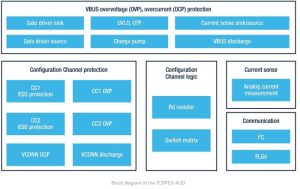
Equally, the TCPP03-M20 features a low-power mode that calls for solely 3 A in an unttached state at 1.8 V, and 10 A at 3.3 V. In that energy mode, the element gives over-voltage safety however would not permit for communication with the USB-C PD controller but. It’s thus a approach for engineers to extend effectivity whereas ready for consumer interactions. The system is able to obtain a cable and both undertake the sink or supply mode. Nonetheless, till the consumer initiates the interplay, the low-power mode will assure the bottom energy consumption attainable.
Why Do Some New Sink Functions Need a Present Monitor?
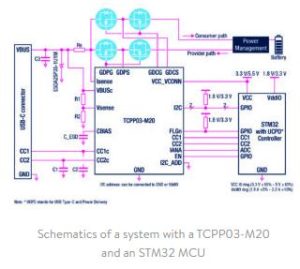 DRP safety can even clear up issues nobody anticipated. Not too long ago, producers of communication programs for first responders expressed the need to make use of a present sensing mechanism with a USB-C sink machine. It might probably assist enhance reliability and security when utilizing these merchandise in very harsh environments, as an example. Nonetheless, sink safety units do not provide present sensing. Due to this fact, they deal with over-voltage safety and do not embody the comparator vital. The TCPP03-M20 solves these points since it may well work with sink units and accommodates the identical present sensor because the TCPP02-M18. Engineers can, due to this fact, provide new redundant protections with out including complexity or blowing up the invoice of supplies.
How you can Get Began?
One of the best ways to get began with a TCPP03-M20 is to seize the X-NUCLEO-DRP1M1. The board works with STM32 MCUs that embody a USB PD controller to create demos quickly. ST even licensed the answer as a 100 W DRP (USB-IF TID: 6408). In consequence, firms reusing our schematics and our supply code present in X-CUBE-TCPP can certify their merchandise quicker. Utilizing the daughterboard and the software program growth package deal can even assist run energy modes demos on the NUCLEO-G071RB or a NUCLEO-G474RE.
For extra info, go to weblog.st.com